Pulse Uptime is an open-source service for monitoring public HTTP and HTTPS endpoints. It runs entirely on Vercel with a dashboard, an API, and a CLI, and deploying your own takes about five minutes.
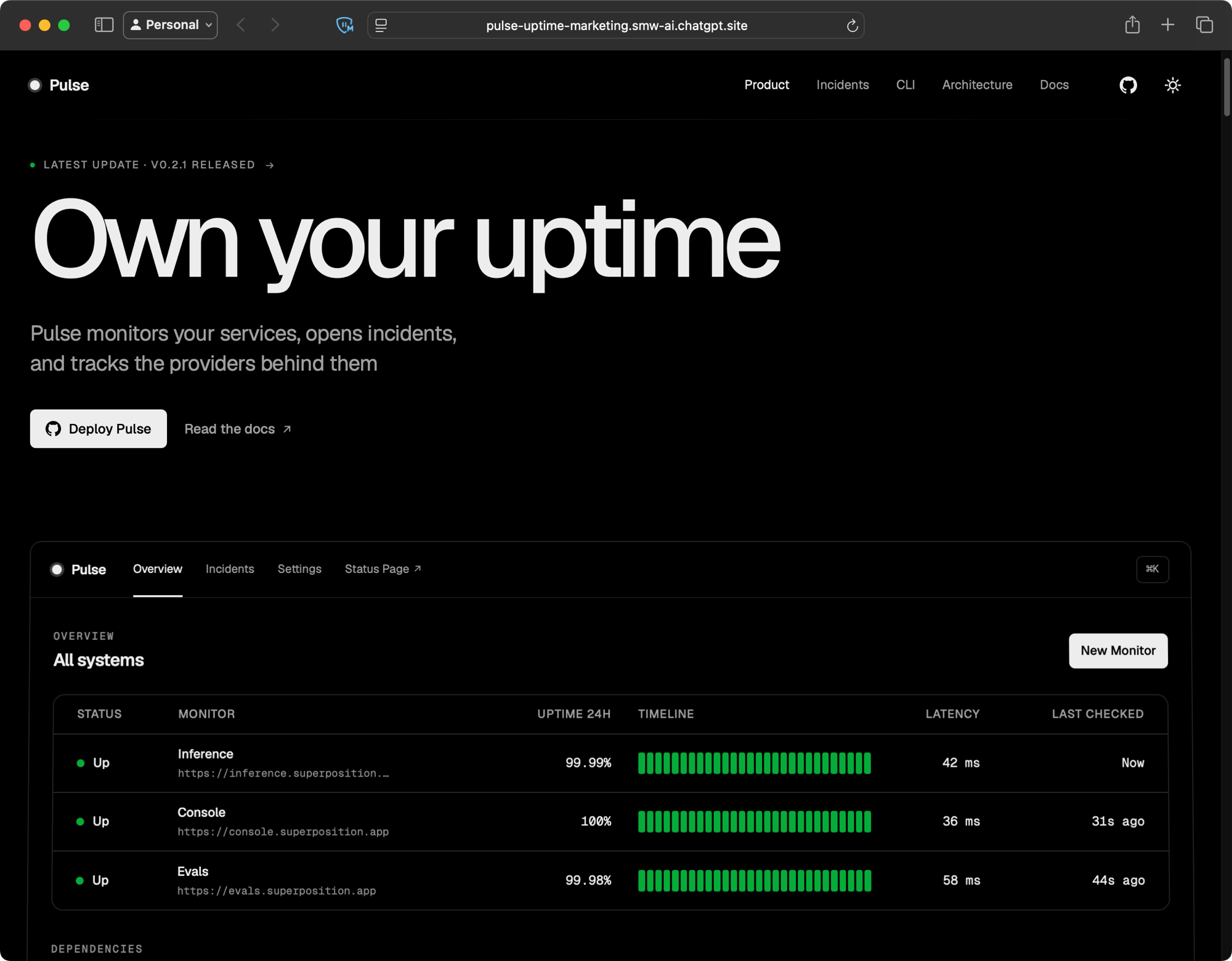 Pulse Uptime marketing hero, "Own your uptime", above a live dashboard demo
I built this for OpenAI Build Week 2026, using ChatGPT to shape ideas and design, and built v0.1 with GPT-5.6 in Codex. I also experimented with new code audit techniques using GPT-5.6 Pro. These audits take over an hour to run, but significantly improve the code's elegance and security.
Capabilities
Uptime monitoring is a mature category, and Pulse covers the table stakes. Check services, confirm outages before alerting, send email alerts, track latency and incident history, and publish a public status page with written reports.
What makes Pulse different is what sits on top of that:
- The CLI offers complete end-to-end control. It's polished for humans, and complete for an agent to deploy Pulse, add monitors, and manage incidents on its own. Agents can audit their own capabilities in real time, including permissions, argument formats, and idempotence semantics. The Pulse expresses every operation's safety model — atomic, replay-safe, or conservative — so agents can automate confidently and trust what the agent claims it can do.
- You can add services from 21 third-party providers like OpenAI, Stripe, Vercel, and AWS in one click, with no credentials, and Pulse mirrors their officially reported status beside your own checks. Pulse alerts you to their service outages, and when your service goes down, it shows whether a provider incident started minutes before yours.
- Domain registration and TLS certificate expiry get amber warnings on the monitor, with issuer, registrar, and verification source on a Domain & Certificate card. Facts are shared by root domain, so fifty monitors on one domain cost one lookup. Connect Porkbun for authoritative renewal and auto-renew state, signed
domain.renewed/domain.expiringwebhooks, and optional email alerts at 30 and 14 days. - Data auto-compacts to keep the database small. Each minute's results are packed together, rolled up into 15-minute, hourly, and daily summaries, and routine details are trimmed as needed. Incidents and failures keep their full detail for up to 2 years, and a storage governor automatically manages retention to fit a 500 MB budget. This keeps history useful and lets you run Pulse entirely on a free tier if you want.
- Pulse secures every layer of the system by isolating sentry checks, reporting failures with detailed diagnostics, and enforcing strict SSRF defenses on each outbound call. Critical operations require advisory locks and live checks before new code is deployed. Health can be externally verified, and all data and credentials stay intact during recovery or lockout. Maintenance always runs in tightly controlled batches.
The review workflow
The hardening and cleanup came from a new technique I used here, and it might be the most complete workflow I've ever gotten out of a single prompt. It works in layers, each one aimed at a specific weakness LLMs have with larger codebases.
Steal the prompt, refine it for your project, and see it for yourself.
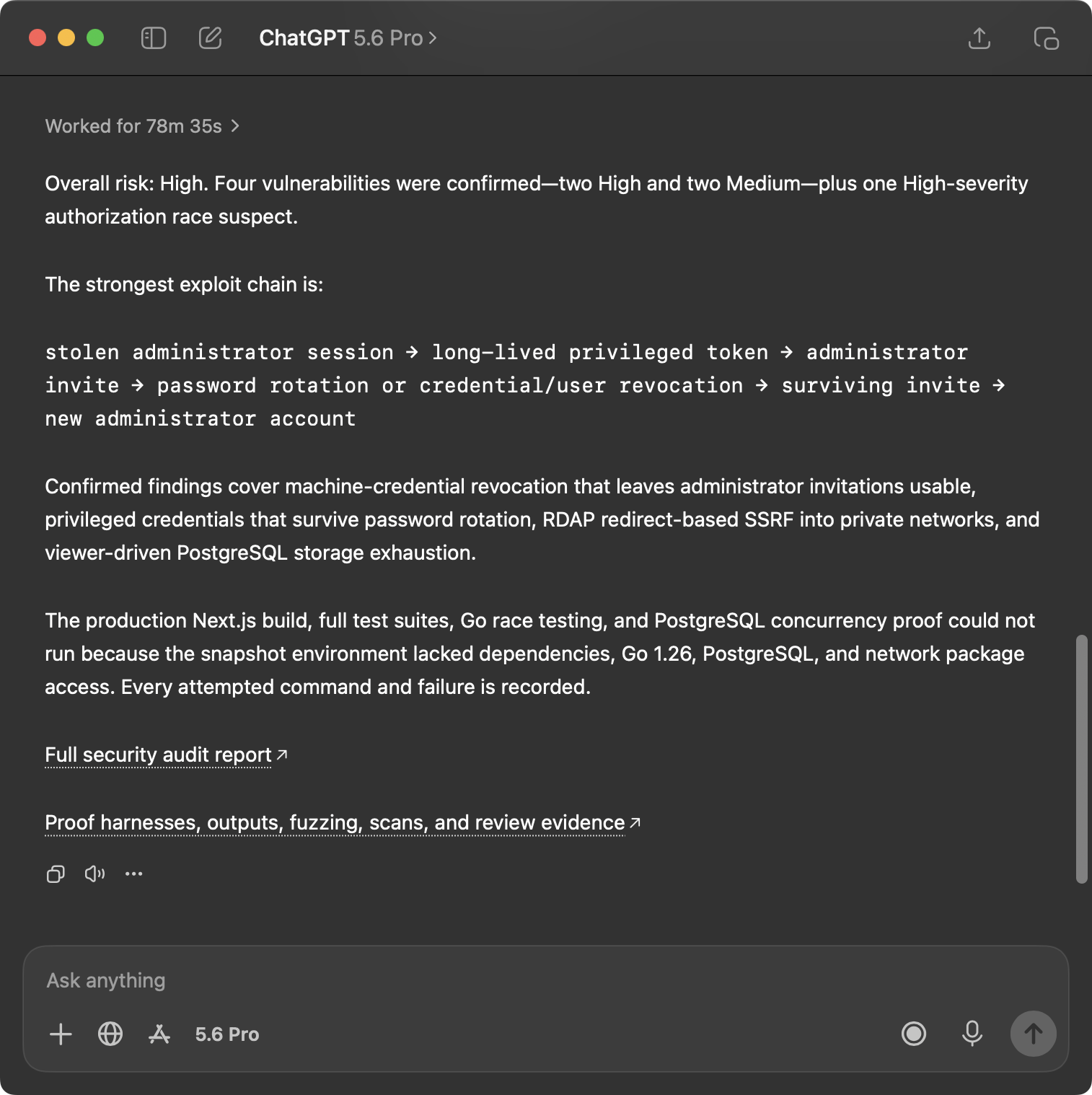 A GPT-5.6 Pro security audit reporting its confirmed vulnerabilities and strongest exploit chain
Running this workflow two or three times, even with long sessions (up to 80 minutes), reliably surfaced new real issues each time that previous passes, and other models, including Fable 5 and Grok 4.5, had missed. This works well in Codex too, but used 15% of my subscription's weekly usage limit.
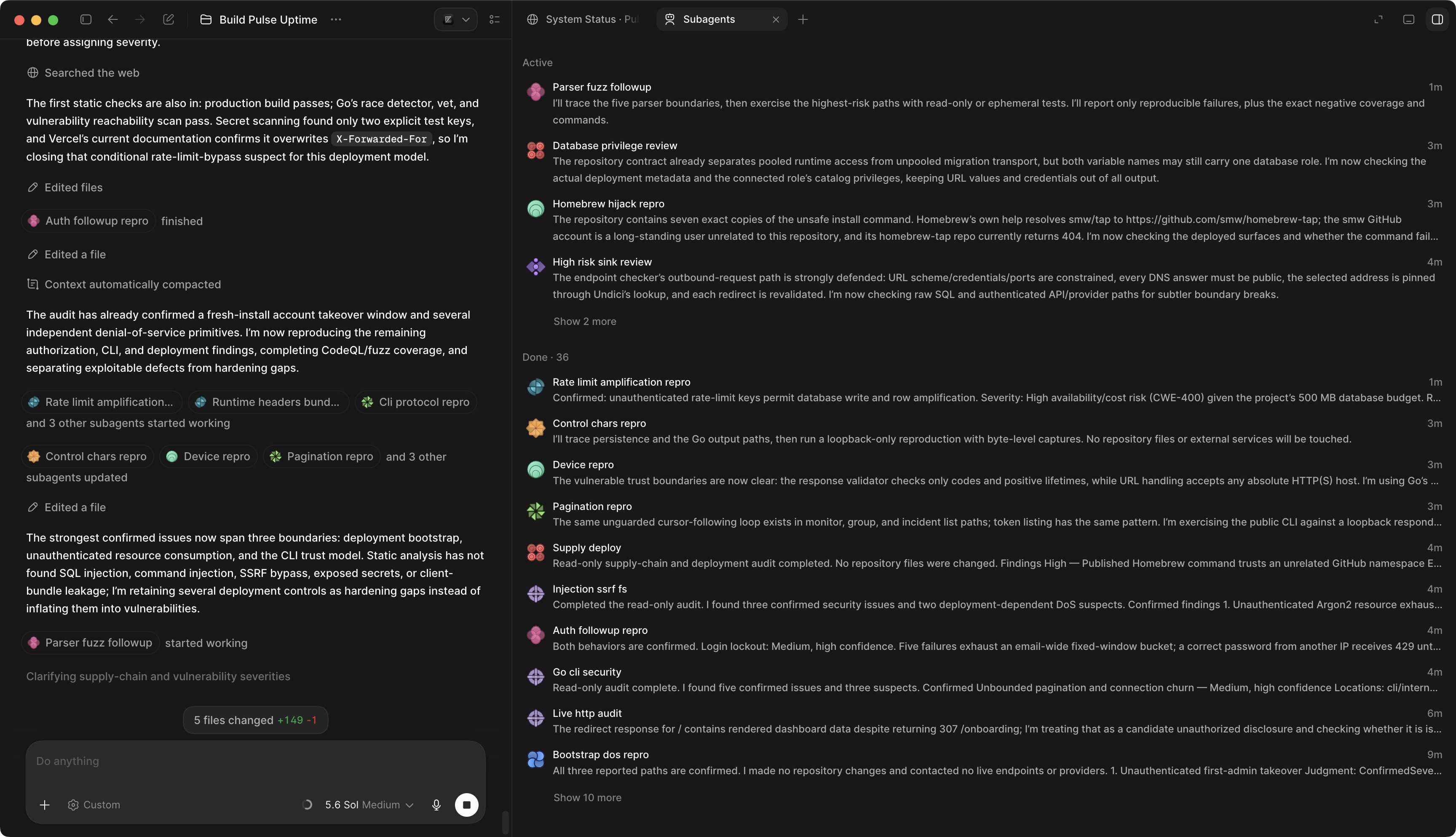 The security audit's subagent pool
The marketing site
The marketing site was a fun part of the project to put together. It's a single static page, but everything is alive. The hero is a working dashboard demo, ⌘K opens a command palette, and an outage simulator plays a failure through detection, alerting, and recovery while the dashboard, incident panel, status page, and email components on the page all follow along in sync.
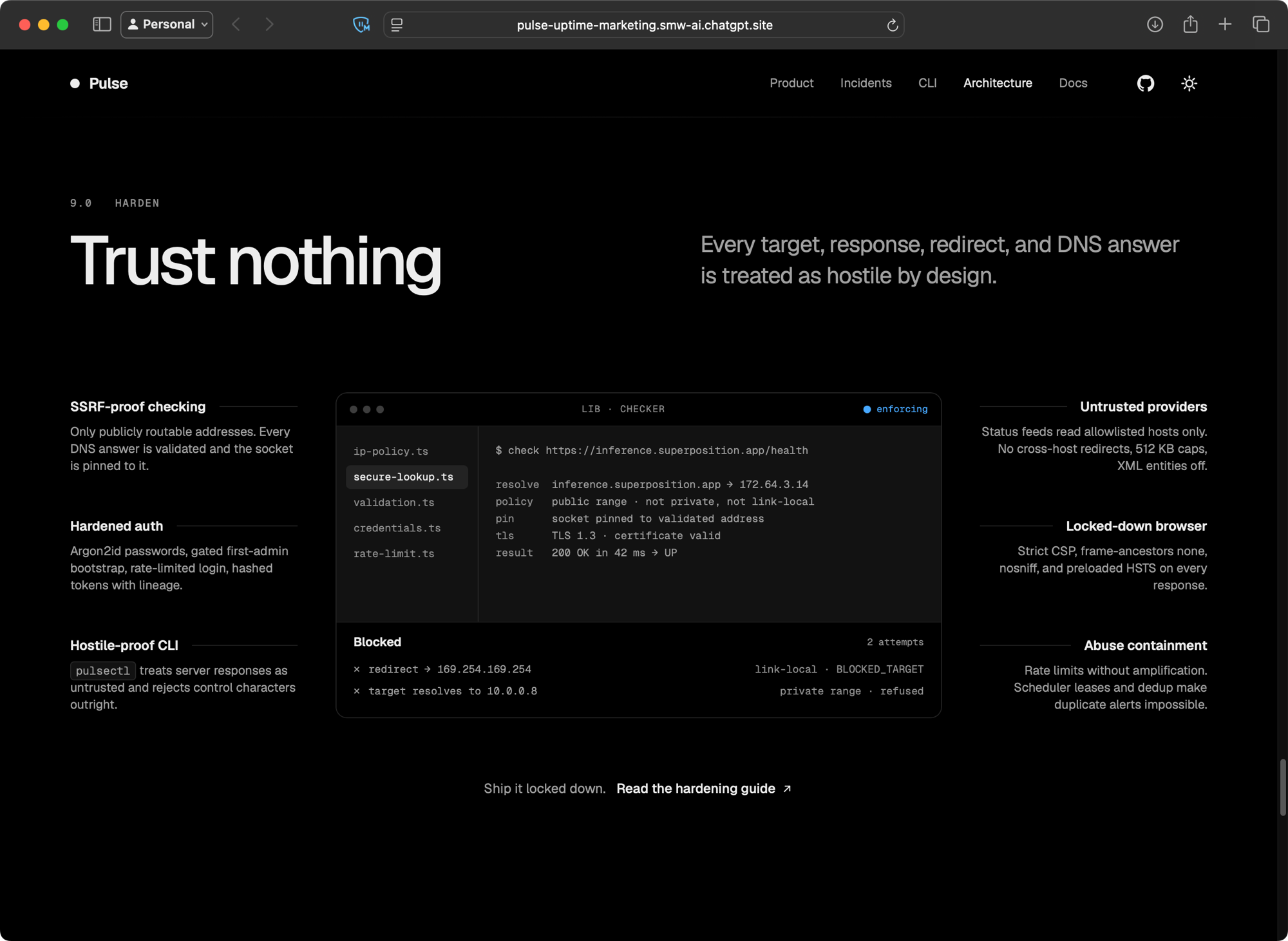 Pulse marketing site hardening section: "Trust nothing"
There's also an interactive terminal with a handful of Easter eggs.
ChatGPT Sites is a cool feature, but working on this project quickly exposed that if your workflow is outside of ChatGPT/Codex, the site quickly falls out of sync.
Roadmap
Most of what I wanted after submission is already shipped: teams with admin and viewer roles and 7-day invite links, the domain and certificate checks above, and a full interactive pulsectl menu you can walk with arrow keys.
Honestly, though, let's see how this goes and what the reaction is. I'm already using this for myself and received more Anthropic notifications than I imagined the service would send.
The code is on GitHub.