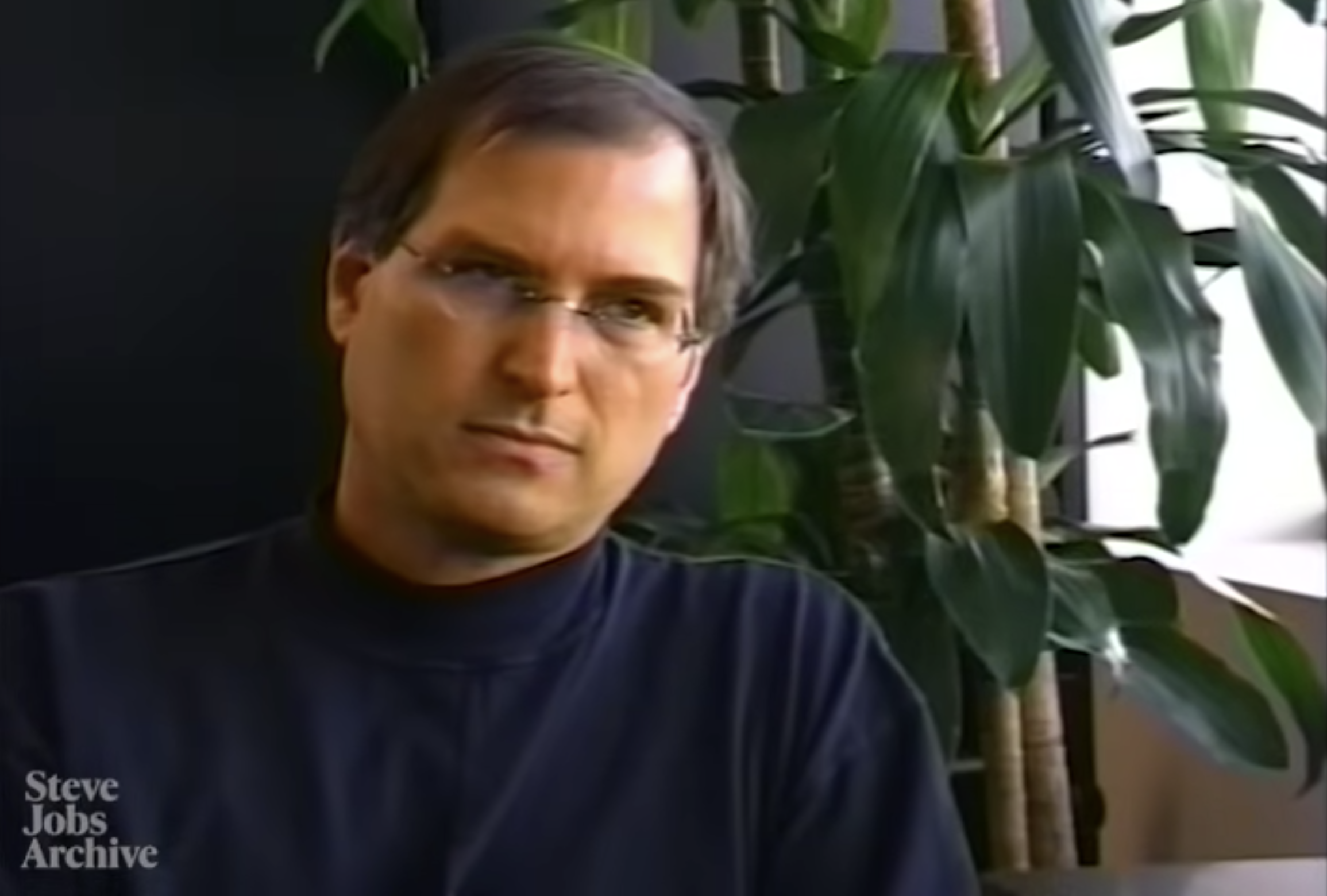
 Steve Jobs discussing Pixar's early days in 1996
1996 sit-down archived by the Steve Jobs Archive where Jobs walks through Pixar's early traction after the release of Toy Story.
This is likely the first interview where Steve Jobs talked about editing films upfront with storyboards, rather than waiting until the end. Previously, this was a comment made during an All Things D 2005 appearance. What you notice is that Steve definitely had talking points, but was masterful at presenting them as novel points emerging naturally in conversation.
Well, on the visual side, 10 years ago, when we made the landmark short film Luxo Jr., it took about three hours on average to render each frame of that short film. Now, fast forward to today, Toy Story, computers are hundreds of times faster. And yet, in Toy Story, it took three hours on average to render each frame. And the reason was the frames were a hundred times more complex in many cases. And we're throwing between 5 and 10 times more computer power at our second feature film, code-named Bugs, than we did in Toy Story. And it'll still take three hours to render each frame, and I think that's sort of a constant. Our ambitions, visually, are growing as fast as the technology can feed them. And so I think the worlds--the visual worlds, which we'll be able to create will be much richer over time.
On the creative side, though, I think the art of storytelling is very old. And no amount of technology can turn a bad story into a good story. I mean, John's taught me that. That's our mantra at Pixar-- it's the story, stupid, if you will. And so I think storytelling is a real art, and that's something that we're always going to be working on very, very hard. And I don't think it's changed in a long time, and I'm not sure it will. And I don't think it's something that technology has anything to do with.
In 2025, it feels like Hollywood has mostly forgotten about great storytelling.