Did we go to the Moon?
The following is an analysis of the Charlie Duke vs. Bart Sibrel debate, with all points extracted from the transcript and evidence researched to corroborate their competing narratives. Each claim is evaluated using Bayesian reasoning to determine which narrative, genuine Moon landings or an elaborate hoax, better explains the available evidence.
Charlie Duke's Points
Personal Mission Experience. Duke's detailed firsthand account of Apollo 16 includes specific sensory details like the Saturn V's vibration feeling "like being on a 360 long limber fishing pole" and the lunar landing at 2-3 feet per second. His description of bounding in 1/6th gravity and collecting 200 lbs of moon rocks, including a 25-lb specimen, provides verifiable technical details that align with mission logs and telemetry data. The consistency between his testimony and independent documentation strongly supports the authenticity of his experience.
Capcom Role in Apollo 11. As capsule communicator, Duke managed the tense Apollo 11 landing sequence, calling the "30 seconds" fuel warning before Armstrong's successful touchdown. His account of the 1202 alarm resolution through backroom guidance from Steve Bales and Jack Garman matches archived mission transcripts and demonstrates the real-time problem-solving that would be nearly impossible to fabricate convincingly across multiple independent sources.
Saturn V Reliability. The Saturn V's perfect flight record of 13 launches with 7.5 million pounds of thrust lifting 6.5 million pound payloads represents proven engineering capability. Duke's observation that they "never had a failure, not one" reflects the rocket's demonstrated ability to achieve the necessary delta-v for lunar missions through straightforward hydrogen-oxygen propulsion and staging principles that were well-understood by the 1960s.
Moon Rocks Evidence. The 840 pounds of lunar samples collected across Apollo missions show unique isotopic signatures from solar wind exposure that cannot be replicated on Earth. Duke's description of the rocks as "gray-charcoal like" with "radiation history that is unique" aligns with decades of peer-reviewed analysis by universities worldwide through NASA's Lunar Sample Laboratory, providing ongoing independent verification of their extraterrestrial origin.
LRO Corroboration. Lunar Reconnaissance Orbiter images at 0.5-meter resolution clearly show descent stages, footprints, and rover tracks at all Apollo landing sites. Duke notes that everything appears "identical... nothing has changed," providing independent confirmation through modern orbital photography that would be impossible to fake retroactively.
No Incentive for Repeated Fakes. The decision to conduct six lunar missions rather than stopping after Apollo 11 contradicts hoax logic, as each additional mission exponentially increased the risk of exposure among the 400,000 people involved in the program. Duke argues that if faking was possible, they would "do it once and shut up," making the multiple missions strong evidence for their authenticity, especially given the absence of credible whistleblowers despite enormous incentives to come forward.
Bart Sibrel's Points
Eyewitness Confession. Cyrus Eugene Akers' deathbed confession lacks independent corroboration and follows patterns typical of fabricated dying declarations. While his son claims video evidence and a VIP witness list, no chain of custody exists for these materials, and the convenient destruction of records through arson and FOIA erasure suggests post-hoc narrative construction rather than genuine cover-up. Military personnel records from this era remain accessible through multiple archives, contradicting claims of systematic evidence destruction.
Government Deception Context. While historical precedents like the Gulf of Tonkin incident establish government capacity for deception, the inductive leap to Apollo ignores crucial differences in scale and verifiability. Unlike covert operations involving small teams, the Apollo program required coordination among 400,000 people across multiple contractors and international tracking stations. The absence of credible whistleblowers despite enormous financial incentives and the program's visibility to hostile foreign powers makes systematic deception implausible.
Destroyed Evidence. NASA's erasure of original telemetry tapes reflects standard archival practices during 1970s budget constraints, not deliberate evidence destruction. The agency preserved broadcast-quality transfers while reusing expensive magnetic tape stock for cost savings. Eugene Cernan's lament about losing Saturn V manufacturing capability refers to industrial capacity and institutional knowledge, not intentional sabotage. The survival of mission transcripts, technical documentation, and thousands of photographs contradicts systematic evidence elimination.
Van Allen Belts Lethal. Radiation exposure calculations must account for trajectory, shielding, and transit time rather than raw belt intensity. Apollo spacecraft aluminum hulls provided adequate protection for the brief polar transit at 25,000 mph, limiting crew exposure to approximately 1 rem—well below acute radiation thresholds. The 2014 Orion video warning addresses prolonged Mars missions requiring months in deep space, not the 15-minute Apollo belt passage. Dosimeter readings from actual Apollo flights averaged 0.18 rem per day, confirming theoretical predictions.
Insufficient Fuel. The rocket equation demonstrates that staged vehicles can achieve exponentially greater performance than single-stage designs. Von Braun's 1950s projections predated Saturn V's revolutionary staging architecture, which delivered the necessary 11 km/s delta-v for translunar injection. Modern Starship requirements for Mars missions involve heavier payloads and orbital refueling for extended operations, making direct comparisons with Apollo's focused lunar objectives misleading.
Faked Halfway Footage. Camera exposure settings naturally underexpose spacecraft interiors when filming bright Earth through windows, creating the transparency effect Sibrel misinterprets. The "Talk" audio likely represents standard communication protocol or technical artifact rather than a filming cue. The 130,000-mile distance claim aligns with mission timeline and trajectory data, while NBC directors' alleged confirmation remains uncorroborated and contradicts archived mission audio.
Non-Parallel Shadows. Wide-angle lens perspective naturally converges parallel shadows toward vanishing points, creating apparent intersection angles that would be impossible with multiple light sources. The 60mm Hasselblad equivalent focal length captures this foreshortening effect when photographing the lunar surface under parallel sunlight. Controlled experiments replicating these conditions consistently produce similar shadow convergence, while studio lighting would create multiple shadows—a phenomenon absent from Apollo photography.
Suspicious Astronaut Deaths. The 15% fatality rate among Apollo-era astronauts reflects the inherent dangers of experimental test flight programs rather than systematic elimination. Only three astronauts died before Apollo 11 (representing 5% of the 55 selected), with the Apollo 1 fire attributed to electrical faults per official investigation. Gus Grissom's widow's murder allegations lack forensic support, while Thomas Baron's train accident, though tragic, shows no evidence of foul play beyond coincidental timing.
Fake Moon Rocks. The Dutch "moon rock" scandal involved a goodwill plaque mislabeled by an ambassador, not samples directly from Armstrong or NASA. Isotopic analysis of the 382 kg lunar sample collection confirms extraterrestrial origin through solar wind signatures impossible to replicate on Earth. While Von Braun did collect Antarctic meteorites, their total mass falls far short of Apollo's documented sample return, and chain-of-custody records through NASA's Lunar Sample Laboratory verify distribution to universities worldwide.
Post-Mission Demeanor. The Apollo 11 crew's subdued press conference behavior reflects normal psychological responses to extreme experiences, quarantine isolation, and the "overview effect" documented in many astronauts. Neil Armstrong's reserved personality, evident throughout his career, remained consistent before and after the mission. "Mr. Cool Stone," Duke calls Armstrong's unflappability. The presence of teleprompters at technical briefings represents standard NASA communication protocol rather than evidence of scripted deception, while Armstrong's later cryptic comments about "truth's protective layers" references a common turn of phrase scientists use when describing breakthrough discoveries.
An elegant rebuttal of every common Sibrel argument available in this two hour video analysis, covering Apollo 17 liftoff footage authenticity, stellar visibility in lunar photography, shadow behavior under parallel sunlight, crosshair positioning artifacts, flag movement in vacuum, wire suspension claims, footprint preservation, moon rock authenticity vs. petrified wood, Van Allen belt radiation exposure, NASA footage manipulation allegations, lost Apollo 11 tapes, missing Saturn V blueprints, lunar module construction materials, rover dust behavior, photographic evidence analysis, international mission tracking, Soviet reactions to Apollo, orbital mechanics verification, delta-v calculations for lunar missions, reasons for program termination, and comprehensive summary of evidence supporting lunar landing authenticity.
Bayesian Analysis
Hypothesis A: Moon Landing Achieved
Charlie Duke describes the Saturn V launch as "vibration from side to side," comparing the rocket to "a 360 long limber fishing pole" shaken at its base. The movement registered as high-frequency sway of mere inches rather than dangerous pogo oscillations.
During the Apollo 11 landing, Duke served as Capcom. He called "30 seconds" remaining on minimum fuel before Buzz Aldrin reported "contact light" signaling touchdown. The 1202 alarm overload during descent was resolved with a "go flight" call from backroom engineers Steve Bales and Jack Garman.
Duke monitored Saturn V development under Wernher von Braun and confirms the rocket "never had a failure, not one." Five F-1 first-stage engines delivered 7.5 million pounds of thrust to lift the 6.5 million pound payload stack using hydrogen-oxygen propellants. Cold War priorities favored "military might" over pure science, producing outsized 1960s budgets that dried up after détente.
Apollo 16 returned "a couple hundred pounds" of moon rocks, which Duke describes as "gray charcoal" with a unique radiation history. Samples were collected in vacuum boxes and remain available for university analysis through NASA's Lunar Sample Laboratory.
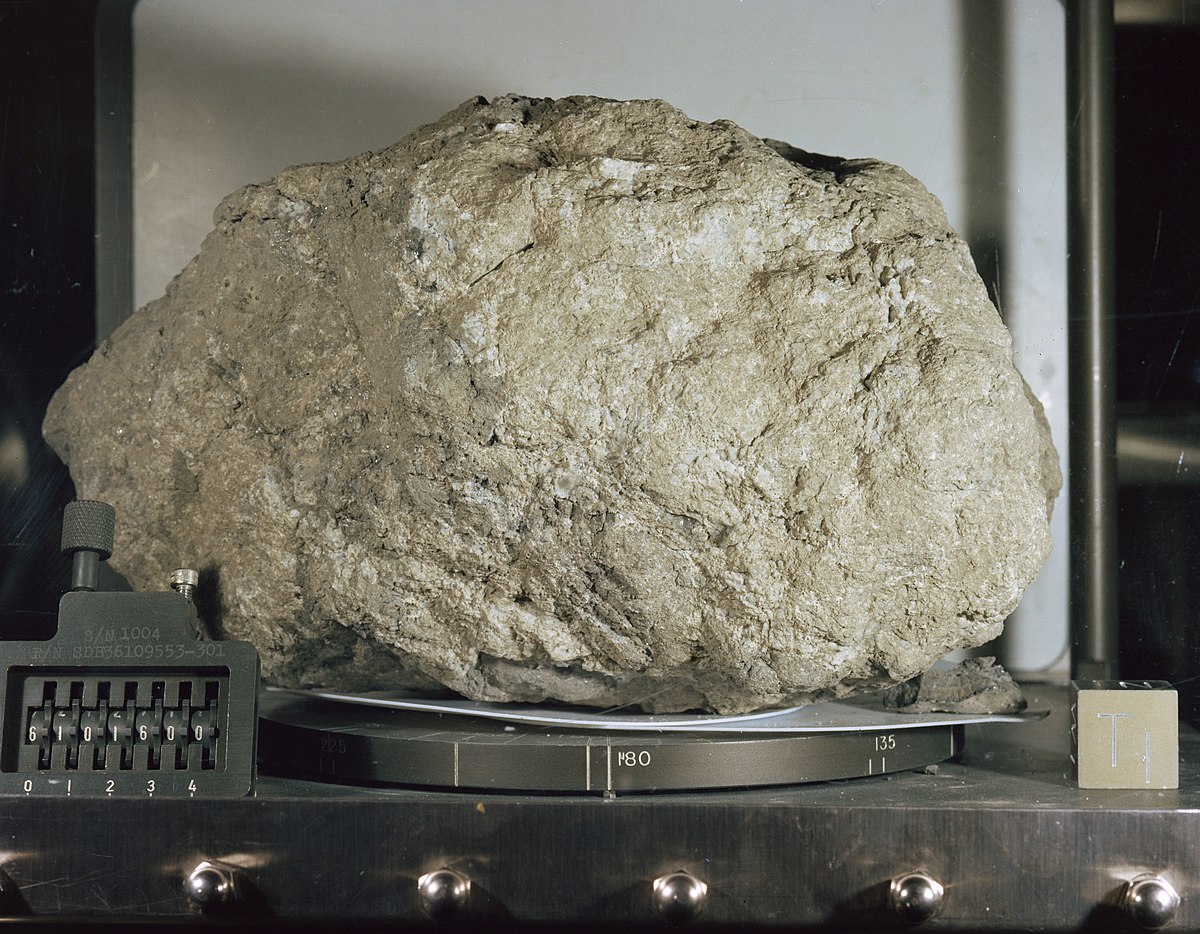 Big Muley moon rock retrieved by Duke during Apollo 16
Charlie provides specific experience-level details, but a more detailed NASA report outlines all of the activities undertook by the Apollo 16 crew over their three-day visit to the lunar surface. Apollo 16 landed on the Moon on April 21, 1972 (MET 104:29:35), in the Descartes Highlands. The crew (John Young and Charlie Duke) conducted three extravehicular activities (EVAs) over approximately 71 hours on the surface, exploring via the Lunar Roving Vehicle (LRV), deploying experiments, collecting samples, and performing geological surveys. The activities are organized below by EVA: EVA-1 on Day 1, EVA-2 on Day 2, EVA-3 on Day 3. Times are in Mission Elapsed Time (MET, hours:minutes:seconds from launch). Locations refer to numbered geological stations or key sites.
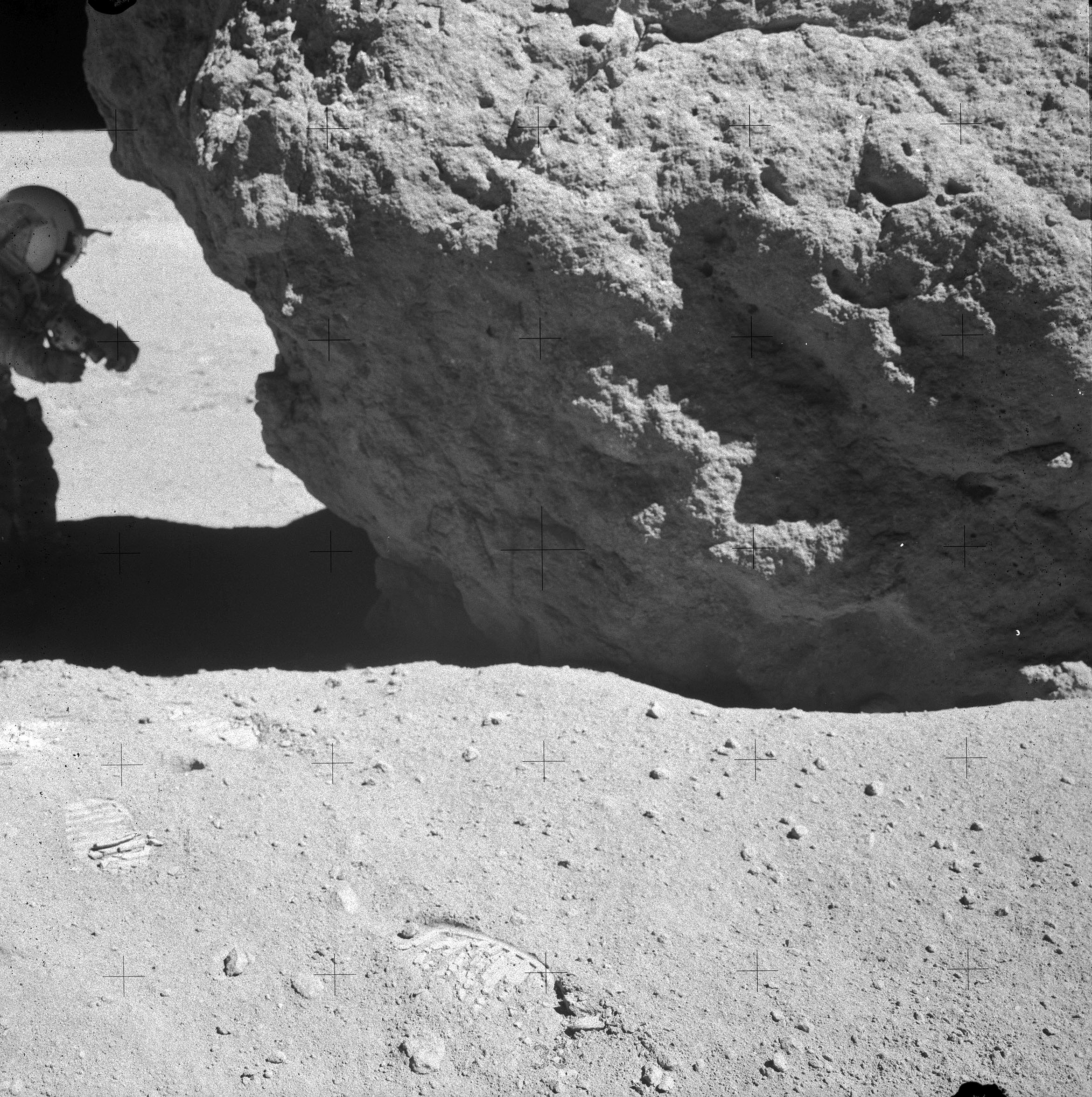 Charlie Duke on the Moon
Lunar Reconnaissance Orbiter images now capture "descent stages, footprints, rover tracks" at all landing sites. These images align precisely with Apollo 16 liftoff video showing undisturbed soil patterns. In 2025, the LRO still operates in lunar orbit, providing imagery, including that of the 2019 crashed Indian rover. In addition to the LRO, there are five other Moon-orbiting probes from China, South Korea, and India. Prior to contemporary probes, 11 other post-Apollo probes orbited and imaged/mapped/scanned the Moon from the US, EU, Japan, India, and China. Apollo missions also left lunar reflectors for telemetry data. Over 500 papers have been published using this data from over 1,000 scientists using historical and modern readings from these sensors. In 2025, from January 15– March 2 the Blue Ghost Mission, the first commercial Moon landing, spent 14 days on the lunar surface and installed new LRRR sensors. An independent scientist later used LRRR data for calculating optimal Moon orbits, concluding that optical navigation is optimal due to cost and error rate, not requiring the standard laser ranging system used to bounce on the LRRR sensors on the lunar surface. Emerging scientific research has moved on to new problems, signaling the consensus belief that this area is solved.
Beyond the laser reflectors and seismic sensors, Apollo missions carried extensive scientific equipment to the Moon. The early missions (Apollo 11 and 12) used a basic science package called EASEP, while later missions (Apollo 12-17) deployed the more sophisticated ALSEP instrument suite. These experiments were powered by nuclear batteries and beamed data back to Earth for eight years until NASA shut them down in 1977 to save money. The laser reflectors still work today since they don't need power—scientists can bounce laser beams off them to measure the exact distance to the Moon.
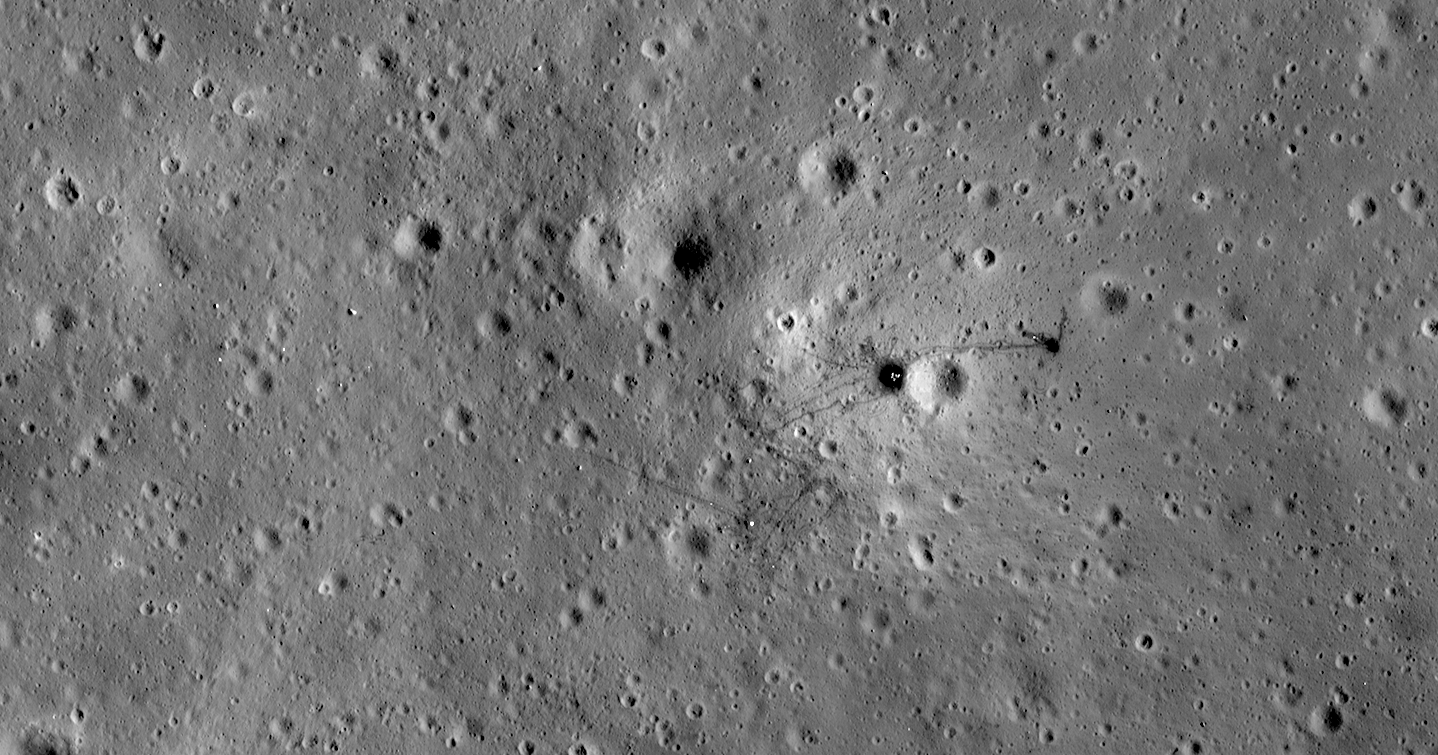 Apollo 16 site LRO image
Apollo missions also left four seismic sensors, actively transmitting from 1969–1977, whose data was re-analyzed in 2011 using modern signal processing techniques and published in the journal Science. Seismic data from Apollo revealed, for the first time, that the Moon has a small partly liquid iron-rich core, a partial melt zone, and a mantle structure supporting its origin from a giant impact.
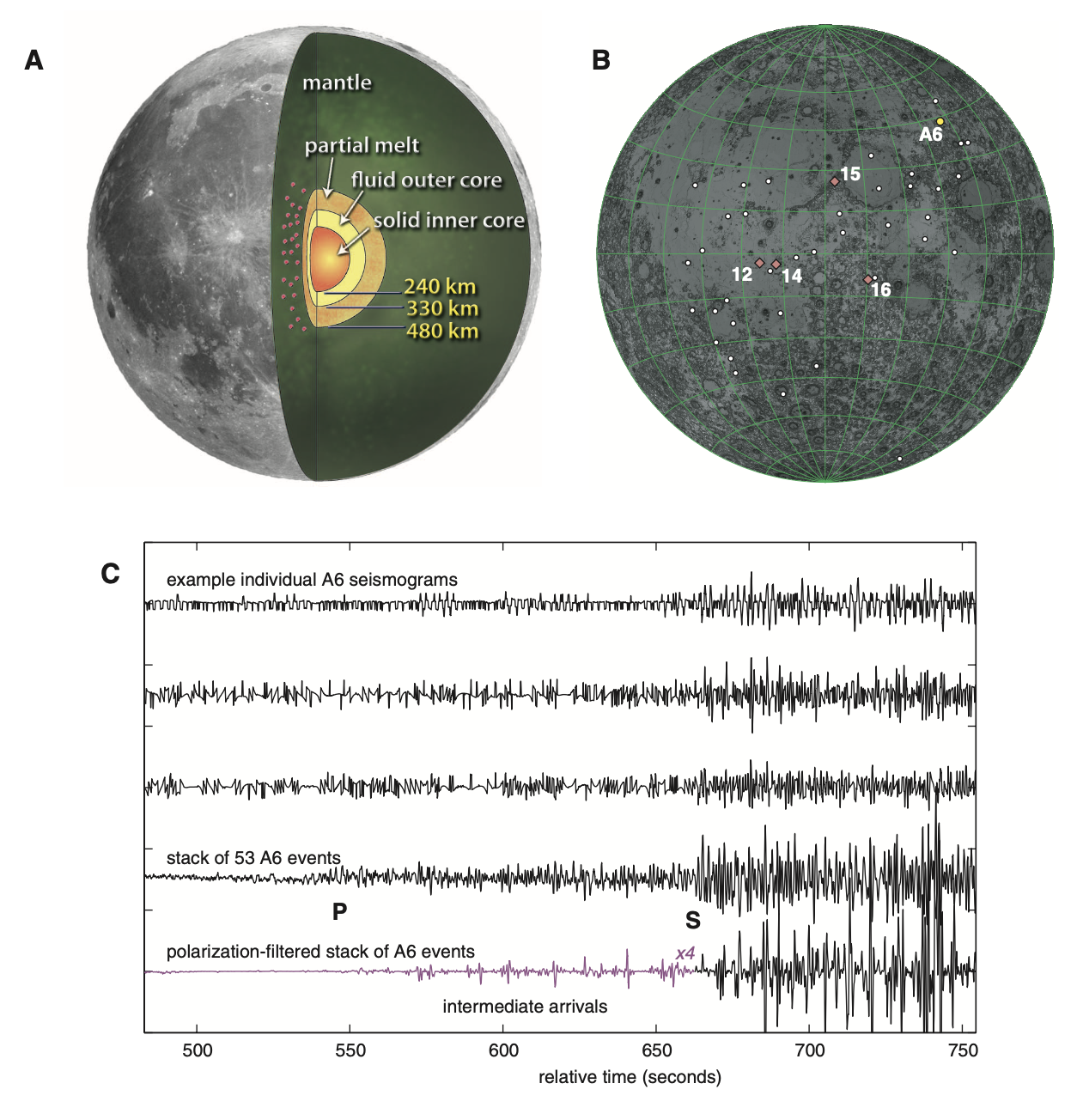 Apollo Moon seismic sensors
The volume of imagery and sensor data relying on sensors from multiple probes and countries makes it incredibly difficult to maintain a hoax narrative when modern evidence shows the contrary. On the question of fabrication, Duke argues: "if you're going to fake something, do it once and shut up." Instead, NASA conducted six landings to meet Kennedy's deadline, involving 400,000 personnel. While his personal argument may seem unconvincing on the surface, the amount of data, evidence, and subsequent travel to space and the Moon supports his point.
When asked about radition, Duke is glib, stating "well, we did it," when presented with the quote from Van Allen regarding the dangers. The aluminum hull limited Van Allen belt exposure to "below 1 rad" over 52 minutes of transit. NASA assessments conclude that "passage through the radiation belts would not pose a significant threat." 2016 reporting correlated radiation exposure to later life heart disease. In 2003, after a string of Moon-hoax tapes circiulated and were covered by Fox News, Van Allen responded to inquiries with the following statement.
The radiation belts of the Earth do, indeed, pose important constraints on the safety of human space flight. The very energetic (tens to hundreds of MeV) protons in the inner radiation belt are the most dangerous and most difficult to shield against. Specifically, prolonged flights (i.e., ones of many months' duration) of humans or other animals in orbits about the Earth must be conducted at altitudes less than about 250 miles in order to avoid significant radiation exposure. A person in the cabin of a space shuttle in a circular equatorial orbit in the most intense region of the inner radiation belt, at an altitude of about 1000 miles, would be subjected to a fatal dosage of radiation in about one week. However, the outbound and inbound trajectories of the Apollo spacecraft cut through the outer portions of the inner belt and because of their high speed spent only about 15 minutes in traversing the region and less than 2 hours in traversing the much less penetrating radiation in the outer radiation belt. The resulting radiation exposure for the round trip was less than 1% of a fatal dosage - a very minor risk among the far greater other risks of such flights. I made such estimates in the early 1960s and so informed NASA engineers who were planning the Apollo flights. These estimates are still reliable. The recent Fox TV show, which I saw, is an ingenious and entertaining assemblage of nonsense. The claim that radiation exposure during the Apollo missions would have been fatal to the astronauts is only one example of such nonsense. — Van Allen, 2003 Statement
These values are mission averages; individual astronaut readings varied by ~20% due to factors like spacecraft shielding and personal activity. Doses to deeper tissues (eg. blood-forming organs) were ~40% lower than skin doses. All were well below the 400-rad mission limit and posed no health risks; equivalent to a few medical X-rays. The bulk of exposure is from the Van Allen belt travel.
Von Braun's economic warnings proved prescient. Rising costs from inflation in prices and salaries made return missions prohibitive, paving the way for SpaceX's commercial approach to payloads. The "extreme cost" halted lunar returns, not technical impossibility.
Hypothesis Z: Moon Landing Faked
Bart Sibrel presents Cyrus Eugene Akers' deathbed confession as central evidence; however there is no direct evidence from Cyrus, only his son telling the story. Akers' son videotaped himself retelling the account, in which his father claimed to witness Apollo 11 filmed at a Cannon AFB hangar on June 1-3, 1968. According to Akers, "hundreds of dump trucks" hauled sand and cement powder to construct a fake lunar set. The operation was guarded under President Johnson's order, with a list of 15 VIPs including Armstrong, Aldrin, and Von Braun. Sibrel has promoted Akers' alleged confession since at least 2021, calling it "highly relevant" eyewitness testimony in his book Moon Man and a NEXUS article. He claims exclusive access via Akers' son and uses it to argue the hoax was filmed at Cannon Air Force Base (AFB). However, it's not "central" to mainstream hoax theories (eg. Bill Kaysing's 1976 book) but is a key pillar in Sibrel's work. Eugene Reuben Akers (Gene Gilmore) recorded and shared the video, which surfaced publicly around 2022. It features Gilmore recounting his father's 2006 confession (Akers died October 11, 2006, of cancer). The video was posted online and provided to Sibrel, who delayed publication per Akers' request due to alleged threats.
In the video and Sibrel's retelling, Akers claimed he guarded Hangar 27 at Cannon AFB (Clovis, NM) during a three-day filming in June 1968 (Sibrel specifies Johnson presided over these days, implying early June like 1-3). The operation was allegedly code-named "Project Slam Dunk." However, no evidence supports this: Cannon AFB logs show no such activity; Apollo 11 training occurred at sites like NASA's Kennedy Space Center and Arizona's Meteor Crater (not NM hangars). Akers was a real Air Force MP stationed at Cannon in the 1960s, but only as a Staff Sergeant; not in a role to "witness" classified filming. Akers/Gilmore described "countless tons" of pulverized concrete (mixed with sand) delivered by dump trucks to simulate lunar regolith, plus Antarctic meteorites crushed for "test samples" by Wernher von Braun. The allged set used two coupled hangars with mountain backdrops, disassembled post-filming. No logistics records, photos, or witness corroboration exist for Cannon AFB in 1968. Apollo sets for training were built elsewhere (eg.Grumman facilities in NY), and real lunar soil was unavailable until 1969.
In 1969, a fist-sized rock presented to former Dutch Prime Minister Willem Drees was displayed for decades at Amsterdam's Rijksmuseum as an authentic "moon rock," even insured for $500,000. Scientific testing in 2009 revealed the object was actually petrified wood, likely sourced from Arizona. The mix-up stemmed from a chain of assumptions: the museum acquired the stone from Drees' estate in 2006, trusting a plaque that read "With the compliments of the Ambassador of the United States of America... to commemorate the visit of the Apollo 11 astronauts to The Netherlands." In reality, U.S. Ambassador J. William Middendorf II gave it as a goodwill memento during the Apollo 11 crew’s October 1969 world tour; Armstrong, Aldrin, and Collins visited the Netherlands, but did not personally deliver moon rocks. The Rijksmuseum never scientifically analyzed the souvenir until media interest in 2009. Correspondence at the time shows the museum consulted NASA (who said its origin was "possible" but unverified) but failed to confirm its provenance. Curators later admitted vetting was poor. Importantly, this rock was not an official NASA lunar sample, had no connection to Antarctic meteorites, and predated President Nixon's authenticated Apollo lunar gifts, which involved actual Apollo samples, 382 kg distributed worldwide. Sibrel cites this isolated diplomatic mix-up as "proof" of wider fraud, but there is no link to genuine Apollo or lunar material, and no similar errors are known among official NASA-documented distributions.
Wernher von Braun, the German-American rocket engineer central to NASA's Apollo program, visited Antarctica once, during the austral summer of 1966–1967, not during the 1946–1947 Operation Highjump (a U.S. Navy mapping expedition he had no involvement in). This was a short NASA-sponsored field trip (about 3–4 weeks) for him and other top managers (eg. from Marshall Space Flight Center) to assess Antarctic exploration as an analog for space missions. There's zero evidence Von Braun collected or transported meteorites. Systematic Antarctic meteorite hunting (via ANSMET) started in 1976, post-Apollo, and yielded the first lunar/Martian ones in the 1980s. Conspiracy claims (eg. he secretly gathered "fake moon rocks") are debunked: Lunar meteorites were rare/unknown then, isotopic differences would be obvious to geologists, and his high-profile role made secrecy implausible. He returned with photos, notes, and operational lessons, not specimens.
Sibrel places Apollo within a broader pattern of Cold War deceptions. The Gulf of Tonkin incident was "falsified" per documented accounts. Bobby Kennedy Jr. alleges CIA involvement in JFK's assassination. Operation Northwoods proposed to "blow up a drone airplane" as a pretext for invading Cuba. Military-driven budgets justified outsized spending that would be impossible today.
NASA erased "original videotapes... due to storage cost and shortages," according to Eugene Cernan. No verified quote from Eugene Cernan, Apollo 17 commander and the last person to walk on the Moon, matches this phrasing in relation to tapes or Apollo technology. Cernan has discussed the challenges of recreating Apollo-era capabilities in interviews and his memoir The Last Man on the Moon (eg. noting how "science and technology had no answers" for the awe of the lunar view), but he does not say "destroyed that technology." This occurred right after Ron Howard's 1999 IMAX request; no sources exist to corroborate this claim. Upon research, NASA did erase the original telemetry tapes containing raw slow-scan television (SSTV) footage from Apollo 11's moonwalk. These were 1-inch magnetic tapes recorded in 1969 and reused (degaussed) in the early 1980s amid a shortage of tapes for new satellite missions. An exhaustive search in 2006–2009 confirmed they were likely destroyed, as over 200,000 tapes were recycled. This predated any high-definition (HD) restoration efforts, which began around 2006 using lower-quality broadcast copies from tracking stations (eg. in Australia). Similar erasures affected other Apollo telemetry tapes, but not all missions' footage was lost—only the raw, unprocessed Apollo 11 SSTV signal. The tape erasures happened in the early 1980s (1979–1985), driven by a genuine shortage for satellite data recording, not 1990s film projects. Ron Howard's Apollo 13 (1995) used available NASA archives and footage, NASA even offered telemetry access during production, but this was post-erasure. The IMAX remaster of Apollo 13 occurred in 2002 (not 1999), with a full-length re-release in 2025 for the 30th anniversary; it involved digital remastering of the film's footage, not original Apollo tapes. No sources link Howard's work to tape erasure or storage decisions in 1999—the erasures predated it by ~15 years.
Telemetry data and lunar module schematics were also destroyed during budget reuse in the 80s and specific knowledge was lost during the 1993 talent exodus caused by "budget changes that favored new employees over legacy ones," during "Faster, Better, Cheaper Era." GAO 1996 review criticized lack of succession planning, directly leading to Mars Climate Orbiter failure in 1999 due to expertise gaps. The 1990s brought talent loss from budget shifts favoring new employees over legacy experts, eroding institutional knowledge; NASA later recruited to reverse it. While some original Apollo telemetry, notably Apollo 11's raw SSTV video, was erased or lost, most mission data—including broadcast footage and later mission telemetry—remains preserved and publicly available; claims that all Apollo telemetry was destroyed are incorrect. Apollo Lunar Module (LM) schematics and engineering documents remain archived and accessible through NASA and the National Archives; claims that this material was "lost" are unfounded.
The Van Allen belts span 30,000 miles and deliver "10 to 100 roentgens per hour" per James Van Allen's 1959 measurements, but Belts are navigable with planning, Van Allen himself endorsed Apollo trajectories publicly in 1962 at an American Rocket Society even. However, Apollo's 15-minute inner belt transit, together with the spacecraft's aluminum hull shielding, kept astronaut doses between 0.1 and 1 rem, well below the threshold for acute radiation sickness (typically 25 rem) and far less than a standard yearly occupational limit for radiation workers (5 rem). Orion engineer Kelly Smith’s warning that "we must solve these challenges before we send people through this region" specifically refers to implementing solutions for longer-term or repeated crewed missions beyond low Earth orbit, not brief transits like Apollo. EFT-1's path was deliberately through riskier zones to stress-test systems, unlike operational missions
As we get further away from Earth, we’ll pass through the Van Allen belts, an area of dangerous radiation. Radiation like this can harm the guidance systems, onboard computers or other electronics on Orion. Naturally, we have to pass through this danger zone twice: once up, and once back. But Orion has protection: shielding will be put to the test as the vehicle cuts through the waves of radiation. Sensors aboard will record radiation levels for scientists to study. We must solve these challenges before we send people through this region of space. — Kelly Smith, Orion: Trial By Fire
Independent verification (eg. Soviet tracking) and lunar samples (382 kg, with solar wind isotopes) confirm deep-space travel. Sibrel claims ignore this, cherry-picking Smith's engineering caution as "admission" while ignoring NASA's 60+ years of data.
Von Braun wrote in Voyage to the Moon that direct lunar flight demands "three rockets... taller than the Empire State Building," each weighing 800,000 tons. This observation targeted economic infeasibility of sustained missions rather than single flights. Von Braun correctly predicted "we stopped going to the moon due to the extreme cost." Elon Musk's requirement of "15 Starships" for Artemis addresses heavier lunar lander needs and high delta-v requirements. Propellant is split into tankers for efficiency, a different architecture than Apollo's lighter design.
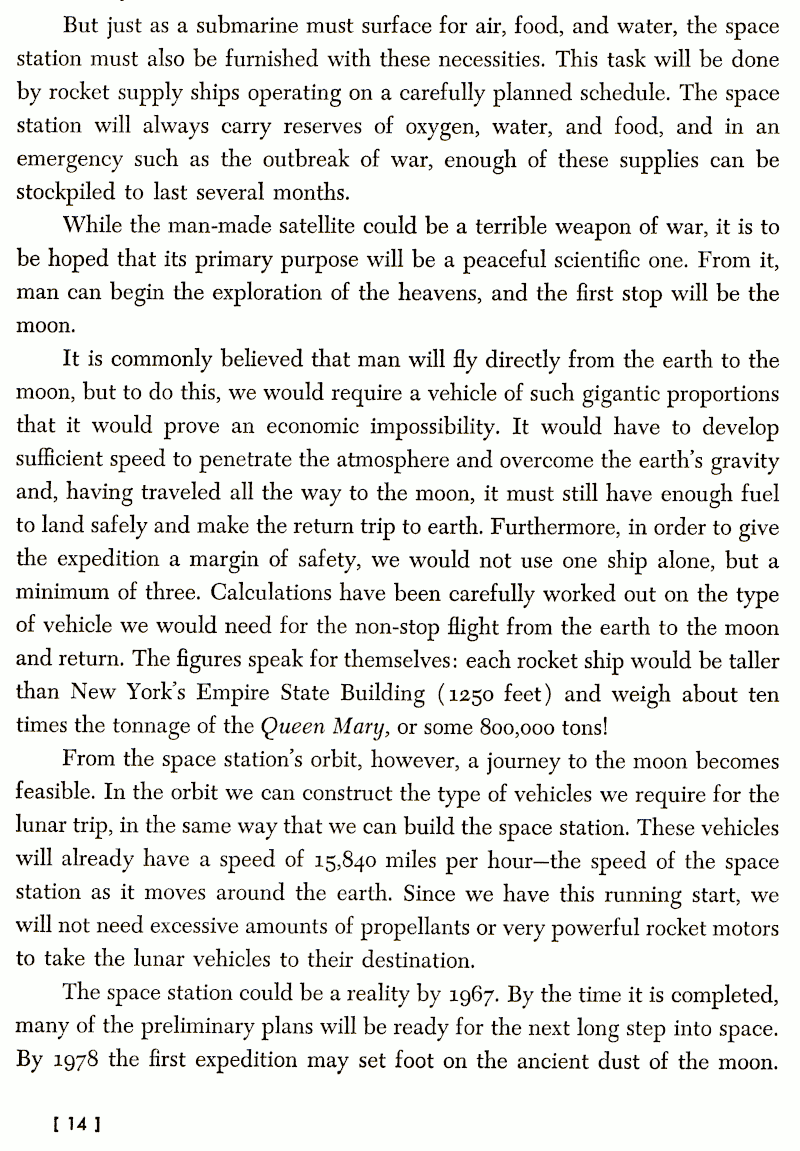 Scan of von Braun's passage
Apollo 11 footage marked "not for public distribution" shows a third-party "Talk" prompt. This segment is clearly a splice; it does not appear in any archival audio or NASA transcripts. The footage shows Buzz Aldrin adjusting exposure on the hatch window, where the Earth view aligns with translunar distance rather than the rapid cloud movement visible from low orbit.
Sibrel claims that Google's "most advanced AI in the world" analyzed Apollo photos and confirmed they were fake during a 2023 demonstration to Putin, but this has been thoroughly debunked. The referenced clip comes from Artificial Intelligence Journey 2023, an AI conference with Sberbank in attendance where Nikolai Gerasimenko demonstrated standard Google Cloud Platform (GCP) fraud detection tools used by banks to identify fake documents, not some secret AI unavailable to the public. According to the original Russian report, Sberbank CEO German Gref specifically noted these were routine American neural network tools, and it remains unclear what specific images were fed into the demo system to generate the entertaining results shown to Putin. Here we catch Sibrel actively manipulating the original article, inserting "most advanced" and "unavailable to the public," and then repeating this on his site and in interviews or debates.
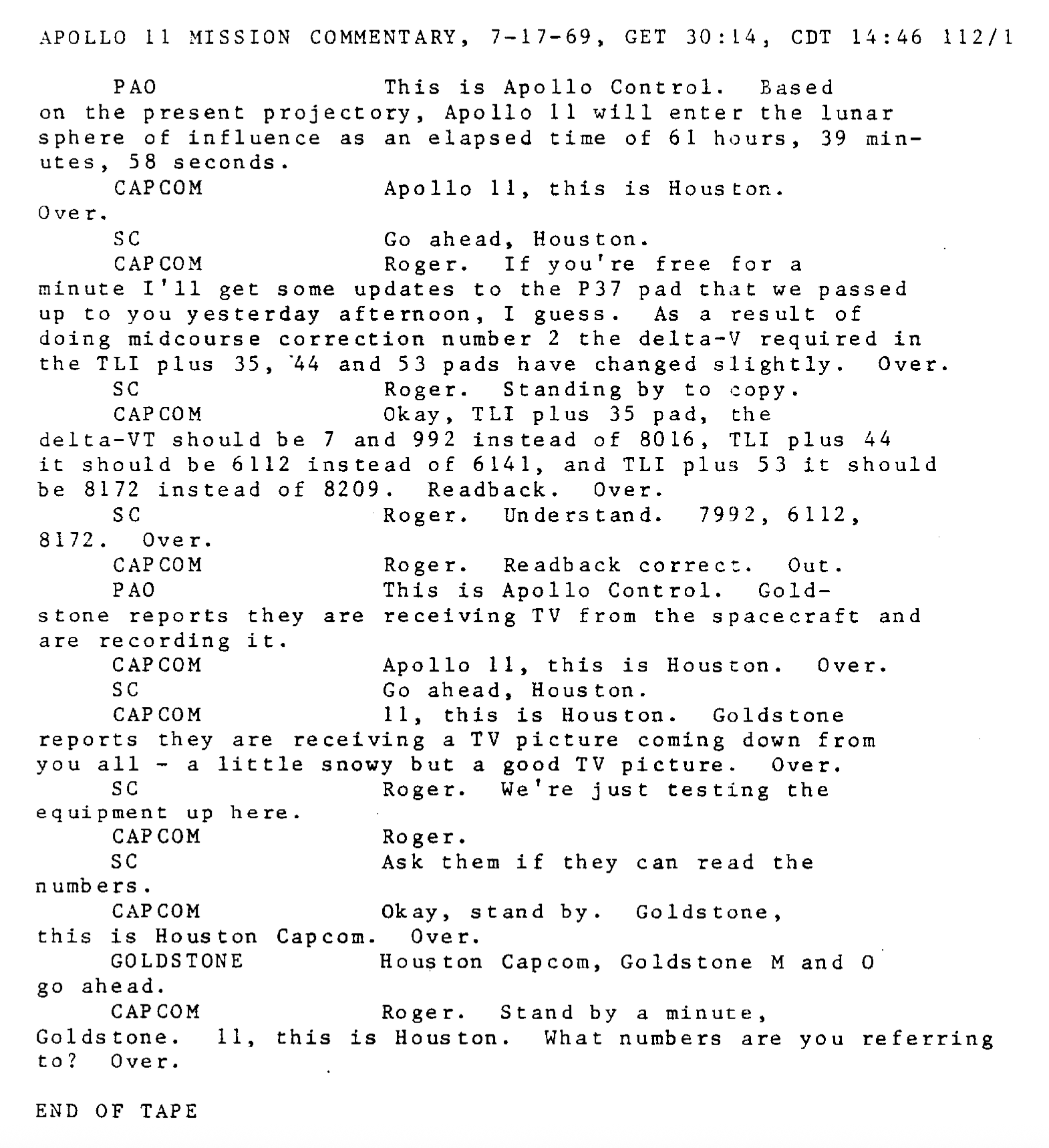 Apollo 11 transcript scan
Apollo 17 photographs show shadows intersecting at 90 degrees from objects five feet apart. Perspective effects in 60mm Hasselblad lenses converge parallel rays. This effect has been duplicated in sunlight setups without multiple studio lights.
Sibrel claims that fifteen percent of Apollo astronauts died in "freak accidents" from 1964-1967 per Fox News reporting. However, no corroboration or evidence of this news report exists. What does exist as a Fox TV Moon Hoax special that cites this figure. The actual record shows 3 astronaut deaths before Apollo I (Elliott See, Charles Bassett in a T-38 crash; Theodore Freeman in another T-38 accident), plus the 3 Apollo I fire victims (Gus Grissom, Ed White, Roger Chaffee). This totals 6 deaths among 55 astronauts selected before 1967; 11% fatality rate, including Apollo I, not 15%. These mortality rates fit the high-risk testing era of experimental aviation.
Additionally, Sibrel claims that Gus Grissom's widow claims he was "murdered by the CIA," citing his pre-fire call: "CIA is all over the launch pad today." Betty Grissom never claimed her husband was murdered by the CIA, but did make a number of statements that her husband's death was caused by gross negligence by North American Rockwell due to ignoring known safety flaws. Her son, Scott Grissom, would echo these comments, extending them further by saying he had "evidence" of intentional tampering, including a short-circuited switch on the capsule destroyed with an explosive device. This evidence was never produced and internal NASA reports attributed the fire to an electrical spark and design flaws. Betty would later retell her son's story in interviews. Sibrel claims to interviewing Betty for "over 4 hours" although no proof of this exists.
Apollo 11's press conference demeanor resembled a "mother's funeral," with hidden teleprompters and Neil Armstrong's post-mission shift to shyness. Armstrong's later interview phrase "remove one of truth's protective layers" is a common expression used to describe scientific discovery. The subdued behavior is attributable to overview effect and re-entry psychological adjustment.
Bayesian Probability Assessment
To evaluate competing claims about Apollo, I'll apply Bayesian probability, a mathematical framework that systematically updates our confidence in hypotheses as new evidence emerges.
This approach treats each piece of evidence as updating our confidence in two competing hypotheses:
- Hypothesis A: The Apollo moon landings were real
- Hypothesis Z: The moon landings were faked
The key insight is that evidence doesn't exist in isolation. Each claim must be weighed by how likely it would be to observe that evidence under each hypothesis, then combined mathematically to reach an overall conclusion.
Consider the moon rocks. If the landings were real, we'd expect samples with unique isotopic signatures from solar wind exposure, distinct from Earth rocks. If faked, we'd expect terrestrial materials or meteorites. The fact that Apollo samples show solar wind isotopes strongly favors the real landing hypothesis.
Conversely, take the "destroyed evidence" claim. If landings were real, routine archival practices might explain missing tapes from the 1980s budget crunch. If faked, we'd expect systematic evidence destruction. Since the erasures follow documented NASA storage policies and only affected some materials, this weakly favors the real hypothesis.
The mathematical framework uses likelihood ratios (LR) to quantify how much each piece of evidence favors one hypothesis over another. An LR of 10 means the evidence is 10 times more likely under hypothesis A than Z. These ratios are then weighted by how concrete and verifiable each piece of evidence is, preventing speculative claims from carrying equal weight with hard data.
The method works by calculating likelihood ratios (LR) for each evidence point. An LR of 5.0 means the evidence is five times more likely under hypothesis A (real landings) than hypothesis Z (hoax). Evidence gets weighted by its concreteness—hard physical data like isotope analysis receives higher weight (0.98) than interpretive claims like astronaut demeanor (0.45).
I start with equal 50-50 odds for each hypothesis, then calculate likelihood ratios for each piece of evidence using , where high ratios favor real landings and low ratios support the hoax theory. Each piece of evidence gets a "concreteness weight" between 0 and 1 based on verifiability — hard physical data like isotope measurements receive weights near 0.98, while subjective interpretations like astronaut behavior get weights around 0.45 — and I use these weights as exponents () so concrete evidence impacts the calculation more than speculative claims. I adjust likelihood ratios downward for hoax evidence with clear alternative explanations (clerical errors, quotes taken out of context) and upward for real landing evidence backed by verifiable physics and archival records, then multiply all weighted likelihood ratios together and convert to probability using .
The evidence overwhelmingly supports that the Apollo moon landings were real. When we analyze all the claims and counter-claims using probability theory, the physical evidence, moon rocks with unique isotopes, laser reflectors still bouncing signals back to Earth, seismic data from lunar experiments, and images from multiple countries' spacecraft, creates a mountain of proof that's nearly impossible to fake.
Product of weighted LRs: (favoring A). Posterior odds: . Probability for A (real landing): or 99.9995% likely that the Moon landings are real. Duke's physical and archival evidence, bolstered by laser ranging, seismic data, and multinational probes that counter Sibrel's anomalies and spuriously-edited evidence, overwhelms interpretive claims by well over five orders of magnitude.
Even the conspiracy theory arguments fall apart under scrutiny. The "destroyed evidence" turns out to be normal archival practices, the radiation concerns ignore actual shielding data, expert quotes from Van Allen, Musk, Smith, and Von Braun are taken out of context to serve a narrative, and the supposed "fake audio" shows clear signs of being spliced together from different sources. Meanwhile, Charlie Duke's detailed technical knowledge and the consistency of NASA's records across decades of missions tell a coherent story that matches the physics.
Even with a highly skeptical prior, where one assumes most of the 1960s was a hoax, with only a 1% chance a landing is possible (odds A:Z = 1:99), the evidence stack (LR product ) drives the posterior odds to about in favor of Apollo. Converting that back to probability gives , so the hoax hypothesis collapses to roughly 0.045%.
The math reasons that the real landings are about 218,000 times more likely than an elaborate hoax. Even if you started out highly skeptical, believing there was only a 1% chance the landings were real, the evidence would still show you to over 99.95% certainty that humans really did walk on the moon.
Bart Sibrel emerges as a systematic distorter who prioritizes narrative over accuracy, repeatedly tweaking credible sources to fit his Moon hoax agenda, utilizing second-hand and uncorroborated stories, exploiting a dead-widow's memory through unsubstantiated claims, lying about the source of sensational information, and manipulating evidence found nowhere else. Rather than a simple fabricator, mistaken or intentionally lying, Sibrel operates as a skilled grifter who edits ambiguities into "proof" through calculated omissions and context manipulation, monetizing these distortions through his films and media appearances. The analysis of his methods demonstrates intentional rather than honest errors, revealing someone who has built a decades-long career on exploiting public skepticism for financial and ideological gain.
Sibrel's distortion of historical achievement represents an assault on the legacy of the 400,000 engineers, scientists, technicians, and support staff who dedicated years of their lives to making human lunar exploration possible. Moon landing denial undermines one of humanity's greatest technological achievements and robs Americans of one of history's most inspiring examples of what we can accomplish through scientific rigor, American ingenuity and cooperation, and bold vision.
If a Moon-landing skeptic does not want to be bothered with the math, they just need to spend a day browsing around the internet for mission data, scientific studies of Moon data and rocks, and the subsequent multi-national Moon imaging efforts that include photos of the left-behind Apollo mission gear.
The Lunar Reconnaissance Orbiter will likely end its mission around 2026 when its fuel reserves are depleted. Short of personally crewing a mission to examine the Apollo landing sites yourself, future lunar orbiters equipped with advanced imaging systems will provide even higher resolution documentation of the equipment and footprints left behind by the Apollo crews.